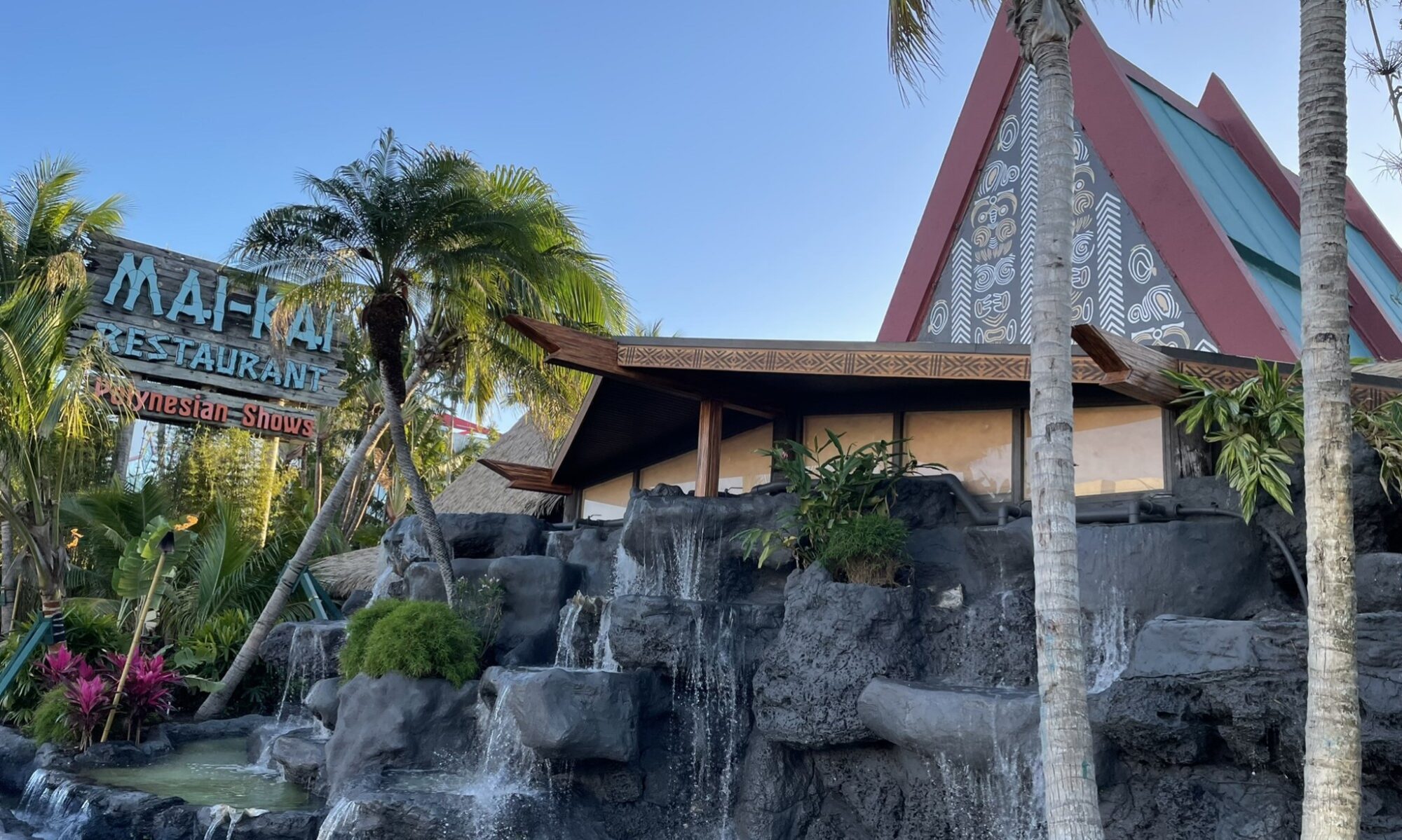
NEW:The Mai-Kai online store
You can now order signature mugs and other merchandise online via the Trading Post’s new e-commerce app.
* Click here to order
Backstage tour posted on Dec. 28, 2011
After outliving the original mid-century Polynesian restaurant fad by more than 30 years, you would think that Fort Lauderdale’s legendary Mai-Kai would be ready for early retirement after turning 55 today. You would be dead wrong.
The grand old dame of Tiki is riding high as the torch-bearing icon of a new generation of Tiki-loving hipsters and cocktail lovers. Reinvigorated by this new wave of Tiki mania, a growing respect and interest in retro culture, continued support by regulars and tourists, plus a million-dollar refurbishment in 2009, The Mai-Kai is still pretty spry.
It may not be the same as the late 1950s, when The Mai-Kai was the largest independent user of rum in the United States (2,000 cases were poured in 1958), but with rum and cocktails in the midst of a renaissance there’s a growing buzz emanating from 3599 N. Federal Highway.
What could be more comforting on a chilly winter night than some warm rum and spices with a big dollop of butter? The holiday season would not be complete without a traditional Hot Buttered Rum.
From The Mai-Kai’s 1956-57 menu.
Like the milk punch, Hot Buttered Rum is a seasonal classic that dates back to colonial times. According to the American Heritage Cookbook, the drink even “found its way into domestic politics.” Candidates would ply their constituents with it to influence their vote. If only today’s politicians would try this method instead of the usual dirty politics.
Drinks using the key ingredients – rum, butter and hot water – were documented during the early days of mixology in cocktail pioneer Jerry Thomas’ mid-19th century bar guides as Hot Rum and Hot Spiced Rum. The Mai-Kai’s version is not very different than the traditional Hot Buttered Rum and was no doubt influenced by Don the Beachcomber’s early Tiki classic.
Hot Buttered Rum and the lesser known Hot Rum Grog were staples on Donn Beach’s early menus. A menu from the 1940s includes this description of the Hot Buttered Rum: “Rums from the islands of Jamaican and Barbados. Mulled with cinnamon, cloves, orange peel, sweet butter and hot water. This will rekindle the fires in your heart.”
The Hot Buttered Rum recipe from the Aku-Aku restaurant in Las Vegas, as published in Beachbum Berry’s Sippin’ Safari.
By the 1950s, Donn’s copycats were experimenting with the traditional recipe, adding creme de cacao (Pub and Prow Hot Buttered Rum), along with maraschino liqueur and black tea (Volcano House Hot Buttered Rum). We can thank tropical cocktail historian Jeff “Beachbum” Berry for these, which he published in Beachbum Berry Remixed (2010) and the Total Tiki app.
Mahalo to the Bum and his 10th anniversary edition of Beachbum Berry’s Sippin’ Safari in 2017, we have perhaps the most reverent Hot Buttered Rum recipe to Donn’s original (rum, honey butter mix, nutmeg, clove, cinnamon). Berry gleaned it from a 1969 issue of the Stardust Hotel’s in-house magazine, but those who follow Tiki history will know that the Aku-Aku restaurant, which operated from 1960 to 1980 in the iconic Las Vegas landmark, has a direct connection to Don the Beachcomber. Beach consulted on its creation and undoubtedly contributed his recipes to the cocktail menu. Sippin’ Safari is a must-read for many great stories about Donn and the Aku-Aku.
The venerable Mai-Kai Polynesian restaurant in Fort Lauderdale will give back to its local clientele next Wednesday with a special party featuring extended happy hour prices and complimentary buffet.
In addition, DJ Mike “The Jetsetter” Jones will be playing some of eclectic “retro-active” tunes plus old Mai-Kai favorites. The bash starts at 5 p.m. in The Molokai bar and half-price food and drink prices last until 9, maybe later.
Drop by to see old friends, make new ones, and marvel at the perfectly preserved mid-century Tiki temple. Management will also bring out the old scrapbooks for those who enjoy Mai-Kai memorabilia and want to take a trip back in time.
According to Critiki.com: “The Mai-Kai is perhaps the last of the grand Polynesian palaces still operating from when Tiki was at its peak in the late ’50s and early ’60s. That The Mai-Kai not only still exists today, but is vibrant and thriving, is something we should all be very grateful for – but not take for granted.”
Don’t let the name “Martinique Milk Punch” fool you. This traditional rum drink, a popular classic during the winter holidays, recently received an upgrade at The Mai-Kai.
Like several other vintage recipes, most notably the Bora Bora and S.O.S., recent updates have replaced the long-established Martinique rum with the sweeter and smokier Demerara-style rum from Guyana.
The improvement is dramatic. The Martinique Milk Punch benefits from the replacement of the earthy and pungent agricole rum and the recent addition of the 86-proof Hamilton rum from Guyana. As a result, the cocktail vaults up an unprecedented eight spots in The Atomic Grog’s rankings, from No. 41 to No. 33. Bora Bora made a similar leap, moving up 10 positions and also increasing from 2 1/2 stars to 3 stars.
Since its return in April 2012, Demerara rum has become a key flavor in many of The Mai-Kai’s traditional Tiki cocktails (see full story). We had not revisited the often-ignored Martinique Milk Punch since we posted this original review in December 2011, so it’s possible that Demerara rum was incorporated into the recipe any time since mid-2012.
With winter cocktails on our mind, we ordered a Martinique Milk Punch in late 2015 and immediately noted the difference. The distinctive Demerara rum flavor shines through with just the right amount of sweetness and a dusting of nutmeg, making for a much more balanced drink. The Martinique rum that The Mai-Kai previously used tended to dominate the other ingredients, its grassy taste a little too aggressive for this mild dessert-style drink.
The Martinique Milk Punch is served in the same glass as two popular ice-cream drinks, the Chocolate Snowflake and Mai-Kai Blizzard. While it’s not on the after-dinner menu, it could easily fill that role.
A traditional milk punch dates back to colonial times. Ben Franklin had his own recipe, which you can check out here. It became fashionable in 18th century England after it was introduced by merchants and often featured whiskey or brandy instead of rum.
It’s unclear if the version using rum from Martinique is indigenous to that island or was created elsewhere. We do know that it was featured on early Don the Beachcomber menus, and this is likely the genesis of the version that was originally served at The Mai-Kai.
It goes without saying that The Atomic Grog is a big fan of any traditional “grog,” and the Yeoman’s Grog at The Mai-Kai is one of the best. But where exactly does the term “grog” come from? And what’s the story behind the Yeoman’s Grog?
Admiral Edward “Old Grog” Vernon. (Portrait by Thomas Gainsborough – from Wikipedia)
In the British Navy, it became tradition in the mid-1600s to grant seamen a daily ration of rum, often replacing the traditional beer, wine, arrack and brandy. In 1731, an official Navy declaration was made granting a daily ration of wine or rum while on foreign stations. The Cocktail Wonk blog features several deep dives into the history of rum in the British Navy.
In 1740, Admiral Edward Vernon – nicknamed “Old Grog” because of the cloak made of grogram (a silk fabric) that he always wore – sought to cut down on rampant drunkenness. So he ordered what by then had become the official daily rum ration of an imperial half-pint (10 U.S. ounces) be diluted with four parts water.
Some years later, when it was believed that citrus fruit prevented scurvy, lime juice was added to the mix along with sugar to improve the flavor. The world’s first proper tropical drink was born, named the “Grog” after Old Grog himself. In the James Beard Award winning book Smuggler’s Cove: Exotic Cocktails, Rum and the Cult of Tiki (2016), Martin and Rebecca Cate pay tribute to a Grog from the 1700s with a recipe featuring 1/2 ounce lime juice, 1/2 ounce Demerara syrup, and 2 ounces of rum. Shake with cubed or cracked ice and strain into an ice-filled old-fashioned glass.
* More on Navy rum: When men were men, and sailors drank Daiquiris
From a classic Don the Beachcomber menu.
Roughly 200 years later, when tropical drinks were all the rage in the mid-century, so were “Grogs.” There was the Colonial Grog from Tiki bar pioneer Don the Beachcomber, Voodoo Grog from Don’s competitor Trader Vic, the Captain’s Grog from the Captain’s Inn (Long Beach, Calif.), and many versions of the Coffee Grog.
But the most famous was easily the Navy Grog, popularized by Donn Beach (aka Don the Beachcomber) and Victor Bergeron (aka Trader Vic), its name and flavor profile paying tribute to the original quaffed on the high seas. Beach is credited with serving it first, dedicating the drink “to the gallant men of the American Navy.” The influence and reach of this classic cannot be understated. Just ask Jeff “Beachbum” Berry, the author and Tiki cocktail archaeologist who dug up most of the aforementioned recipes and published them in his six seminal books and app.
In the introduction to Potions of the Caribbean: 500 Years of Tropical Drinks and the People Behind Them (2014), the influential writer talks about the life-changing moment he had 30 years earlier, “sitting in a restaurant I couldn’t afford while sipping a drink I didn’t understand. The restaurant was Trader Vic’s, the drink a Navy Grog.” The self-described “Tiki nerd” became obsessed with finding out why he liked the drink so much and figuring out where it came from. The rest is Tiki revival history.
The Yeoman’s Grog is a favorite of Tiki historian and author Sven Kirsten, seen here sharing a toast with Hurricane Hayward on New Year’s Eve 2016 in The Mai-Kai’s Molokai lounge. (Atomic Grog photo)
But Berry was just one of many famous (and infamous) figures who were smitten with the Navy Grog. It was believed to be one of Frank Sinatra’s favorite drinks (even though ‘Ol Blue Eyes preferred Bourbon). President Richard Nixon was a fan, sneaking away from the White House to quaff a few after hours at Trader Vic’s in the Capitol Hilton. Not coincidentally, Nixon was a Navy lieutenant who served in the South Pacific. In 2003, record producer Phil Spector enjoyed several Navy Grogs at the Beverly Hills Trader Vic’s the night he murdered actress Lana Clarkson. Court testimony by a Vic’s bartender included reference to the drink’s robust 3 ounces of rum.
Don the Beachcomber’s version also features 3 ounces of rum, and both employ grapefruit and lime juices. The only major difference is the sweetener: Donn Beach preferred his signature honey mix, while Trader Vic used an allspice syrup. Trader Vic’s restaurants use a proprietary “Navy Grog Concentrate,” but Berry has revealed (and taste tests confirm) that this is indeed just a fancy syrup.
Which of the two classics is best depends on who you ask. They’re roughly equal in our estimation. So we checked The Grogalizer, the Tiki home-bartending site that features ratings of some 500 cocktail recipes from Berry and Cate, plus more. With 81 votes, Don the Beachcomber’s version rates 8.2 (out of 10), while Trader Vic’s version scores 7.5 on 22 votes.
Organizers of the largest annual celebration of Tiki culture on the East Coast went straight to the event’s loyal following when it came time to plan the 2012 event. The result? An earlier date and other exciting changes that have just been announced on the event’s totally redesigned website, TheHukilau.com.
The Hukilau, which spent the past five years in early June, now moves to April 19-22 as the result of a poll of its Facebook fans. The earlier date promises milder weather and more separation from the other major summer events.
Activities will again be centered around two beachside hotels plus the legendary Mai-Kai restaurant, which is celebrating its 55th anniversary this month. But months of feedback from Hukilau fans resulted in several changes: More events at The Mai-Kai, a more budget-friendly hotel, and a more laid-back schedule with time to enjoy the company of friends and South Florida’s abundant beaches and beauty.
One thing that hasn’t changed, however, is The Hukilau’s commitment to high-caliber entertainment and educational symposiums. Among the 2012 highlights are: Nashville surf/spy/space supergroup The Martian Denny Orchestra; a symposium on the mysterious Zombie cocktail by influential mixologist and author Jeff “Beachbum” Berry; a hands-on symposium by tattoo artist and historian Paul Roe; and several performances by acclaimed burlesque star Angie Pontani.
Here’s an overview of this magical Polynesian weekend in America’s Vacationland:
The creators of a new documentary on the rise, fall and resurgence of Tiki culture have announced that artist Kevin Kidney has been hired as art director.
Tiki enthusiasts from around the world gathered at The Mai-Kai in Fort Lauderdale during The Hukilau in June 2011. (Photo by Go11Media.com)
Much of Plastic Paradise was filmed last June at The Hukilau and the historic Mai-Kai restaurant in Fort Lauderdale, and there are plans to show a sneak preview during next year’s Polynesian Pop extravaganza, scheduled for April 19-22. Plastic Paradise is then slated to hit the festival circuit, followed by airings nationwide on PBS affiliates.
The documentary, an hour-long chronicle of Tiki culture, was commissioned by PBS. The filmmakers, known as Common Machine, had previously provided PBS with an award-winning film about Cuban artists living in Miami, Hecho a Mano: Creativity in Exile.
* Click here to see a preview of Plastic Paradise
There’s a fascinating new documentary airing this month on WLRN, the local PBS television station: Prohibition and the South Florida Connection. This one-hour film by award-winning journalist Steve Waxman chronicles a colorful and chaotic period of U.S. history with a special focus on South Florida’s role.
Through interviews, archival photos and video, the program takes an in-depth look at the region’s relationship with rum importers from the Bahamas, along with the culture of profits and crime that defined this infamous era. From Al Capone to local speakeasies to the corrupt police, it reveals a wanton yet endearing chapter of South Florida history.
Few realize that the Zombie – not the Mai Tai – is the drink that kicked off the tropical drink craze. Created in the 1930s by the Dr. Frankenstein of tropical mixology, Donn Beach (aka Don the Beachcomber), the Zombie remains his masterpiece.
Beach’s mad scientist approach to combining multiple rums, juices, syrups and spices was groundbreaking and set a standard that remains an influential touchstone for today’s bartenders in both the Tiki and craft cocktail worlds. But if it weren’t for cocktail sleuth, historian and author Jeff “Beachbum” Berry, we might not have ever discovered that legacy.
Berry rescued the Zombie (and many other Tiki classics) from bad bartending and half-assed attempts to re-create the originals. But his first attempt at the Zombie in his seminal 1998 book, Grog Log, was not a whole lot better than the imitators. By 2002, however, he had begun to unearth some great Zombie recipes, three of which are published in his second recipe book, Intoxica. One of these, later dubbed the “mid-century version” and purported to be a Don the Beachcomber recipe published in 1950, is shown below.
But Berry was just scratching the surface of Zombie lore. His 2007 masterpiece, Sippin’ Safari, yielded the motherlode. An entire chapter, “A Zombie Jamboree: The Curse of the Undead Drink,” provides the definitive research on the elusive cocktail. There’s more background on the 1950 Zombie, plus a much different 1956 version attributed to the Don the Beachcomber restaurant in Waikiki.
Beachbum Berry mixes a classic Zombie at the Zombie Jam at The Mai-Kai on April 25, 2011.
The pièce de résistance, however, is Berry’s discovery of a 1934 recipe for “Zombie Punch” in the notebook of 1930s Don the Beachcomber bartender Dick Santiago. The find was considered the Holy Grail of lost tropical drinks, but one frustrating puzzle remained to be solved: the cryptic ingredient listed as “Don’s Mix.” This combination of grapefruit juice and cinnamon syrup has now become a common ingredient, but the 2007 revelation was a landmark in the Tiki drink world. Berry and Cocktail Kingdom later released a 10th anniversary edition of Sippin’ Safari, which includes additional recipes, both old and unpublished, plus new ones from the Tiki revival.
* BeachbumBerry.com: More on Berry’s search for the original Zombie | Books and Total Tiki online + app
In 2010, Beachbum Berry Remixed continued the tradition of digging deeper into the history of the drink that started it all. In addition to the discoveries in Intoxica and Sippin’ Safari, Berry presented several new recipes, including a simplified version of the complex creation. You can also find Berry’s Zombie recipes in his Total Tiki app for iPhone and iPad, a unique repository of more than 250 exotic drink recipes from yesterday and today. Launched in 2022, Total Tiki Online is subscription service accessible via all platforms that takes the app to the next level with exciting new information management features.
If you desire a more tactile way to enjoy Berry’s handiwork, pick up a set (or a case) of his signature Zombie Glasses from Cocktail Kingdom, which include the original 1934 and 1950 recipes on the side along with distinctive artwork and packaging. They’re also available at the author’s New Orleans bar and restaurant, Beachbum Berry’s Latitude 29, along with the Bum’s own twist on the vintage recipe.
A contemporary Zombie from “Beachbum Berry Remixed.”
In addition to his acclaimed books, app and barware, Berry had a profound influence on today’s Tiki and cocktail scenes over the past decade or two by way of his entertaining and boozy symposiums around the world. His first-ever Zombie seminar took place at The Mai-Kai in April 2011 during the Miami Rum Fest. He resurrected that talk at The Hukilau in April 2012, again at The Mai-Kai, with a few additional surprises. [Full coverage]
Of course, The Mai-Kai’s Zombie is a descendant of Don the Beachcomber’s classics. There’s a reason it’s the top-rated cocktail in this guide, and the only one with a perfect rating of 5 out of 5 stars. Perhaps its the complex, undefinable flavors. The Zombie stands atop the tropical cocktail mountain as a true original with its intense flavors and high potency.
Despite its seeming cacophony of flavors, the Zombie (when made correctly) achieves perfect balance. The combination of spices are exotic and unique. The sweet juices and syrups are counteracted by intense anise and sour notes. And the coup de grâce is the blend of three rums in perfect harmony.
Information has been leaking out for months via Facebook but it’s finally now official: TheHukilau.com has launched for 2012 with a list of activities and info, ticket prices and online ordering. The Atomic Grog is happy to present some exclusive, additional details.
The biggest news for the April 19-22 Polynesian Pop extravaganza: A new host hotel, even more events at The Mai-Kai, and a special Beachbum Berry cocktail symposium. While a new Web designer puts the finishing touches on the 2012 site, Hukilau producer/organizer Christie “Tiki Kiliki” White filled us in on some of the details:
New host hotel: The beachside Best Western Oceanside Inn will offer festival attendees a more affordable and intimate experience, Tiki Kiliki says. It’s located just south of The Hukilau’s longtime party central, the Bahia Cabana Beach Resort. You can make reservations at both hotels now by calling the phone numbers listed on TheHukilau.com. To get the best rooms at special group rates, you must call these numbers now instead of making reservations online.