Updated Jan. 20, 2014 NEW: The new cocktail menu made its public debut on Jan. 17. Check out our review and recipe for the new drink, the Tiki Swizzle.
**********
The Mai-Kai celebrated its 57th anniversary with a customer celebration party that not only recognized the landmark Polynesian restaurant’s storied past, but also looked ahead to the future. * See below:New tropical drink menu sneak preview
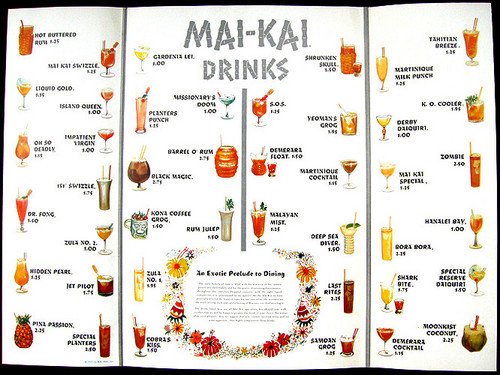
The Mai-Kai’s new cocktail menu (right) harkens back to its 1956 original (left), with all the drinks displayed on an impressive centerspread. (Photo by Hurricane Hayward)
There was much to celebrate at the Saturday, Dec. 28, event: The recent historic designation by the city of Oakland Park, the 50th anniversary of a longtime employee, and the screening of a new PBS documentary filmed at The Mai-Kai. But attendees were also given a sneak peak at what’s to come: The first major redesign of the Tiki palace’s iconic cocktail menu in more than 30 years.
The celebrating actually started on Friday night, with a rare South Florida performance by instrumental surf band The Novarays in The Molokai bar. The Orlando band ripped through three sets of classic covers and original tunes. On Saturday, the bar was nearly full at 1:30 p.m. for an early happy hour to kick off the day’s special events.
The several hundred guests then filled the main dining room, which sits beneath the original, awe-inspiring A-frame structure built in 1956 by brothers Bob and Jack Thornton, a couple upstart restaurateurs from Chicago who envisioned the world’s grandest Polynesian palace in Tiki’s mid-century heyday.
Like a fine barrel-aged rum, the new magnum opus from Tiki cocktail historian Jeff “Beachbum” Berry benefited from years maturation, developing a rich depth of flavor and nuance. When Potions of the Caribbean: 500 Years of Tropical Drinks and the People Behind Them is finally uncorked next week, it will undoubtedly be savored to the last drop by a growing legion of fans.
It could also quite possibly be Berry’s last call as a self-proclaimed “layabout” author. While the carefree image will likely remain, Berry’s other much-anticipated project could soon make him a much busier Bum. The former screenwriter, whose six books since 1998 have sown the seeds of the Tiki cocktail revival, will be embarking on a new career next year when he opens his own bar in New Orleans.
These plans are accelerating, Berry confirmed in an e-mail this week, and he hopes to sign a lease at an undisclosed location by the end of the year. That would put him on track to open his Tiki bar (in partnership with Mrs. Bum, aka Annene Kaye) as early as spring 2014. They already have a designer, architect and key staff lined up. In the meantime, Berry’s solo career as a literary figure will reach its peak with the release of Potions of the Caribbean.
Berry’s sixth book on tropical drinks and the fascinating stories behind them, Potions of the Caribbean could be considered the sequel to Sippin’ Safari (2007), both in style and substance. Berry’s first three books were mainly spiral-bound drink recipe compilations, and his previous (Beachbum Berry Remixed, 2010) was a redesigned and expanded re-release of the first two.
But with Sippin’ Safari, Berry used his seemingly endless supply of vintage recipes, photos and artwork to embellish the stories of the bartenders, restaurant owners and other pioneers of the early days of Tiki. The result was a wonderful read – a beautifully illustrated cocktail guide, history book and retro culture travelogue all rolled into one. The new book follows this same format, with the stories taking a starring role and the recipes enhancing the narrative.
The rich history of the Caribbean and its role in the Tiki cocktail movement was actually supposed to be an additional chapter of Sippin’ Safari. A subtitle near the end of the book’s final chapter, which tells the story of Mariano Lucidine and The Mai-Kai, introduces the Potions of the Caribbean name while very briefly mentioning the birthplace of rum and its role in Tiki cocktails.
Berry explained his dilemma on the Oct. 29 episode of The Quiet Village podcast. “I was trying to cram all this stuff into one chapter,” he told host Digitiki. “After we talked about The Mai-Kai, I was just going to go down to Cuba and Jamaica. But I realized there was just way, way too much stuff to do that, so it became its own book, five years later.”
You may have seen Martin Cate igniting flaming bowls of fun on the Cooking Channel or entertaining attendees at Tiki and rum events around the world. If you’re a cocktail or rum enthusiast, you’ve certainly heard of Smuggler’s Cove, his San Francisco lair that has redefined the modern rum cocktail and has been acclaimed as one of the world’s best bars, period.
Smuggler’s Cove
He’s also somewhat of a hero to the Tiki home bartending community, quickly rising from hobbyist on the Tiki Central message board to bartender at the Trader Vic’s flagship San Francisco location in 2005, to Forbidden Island, his first acclaimed Tiki bar in Alameda in 2006. He sold his interest there and opened Smuggler’s Cove in 2009.
In April, while Martin was in South Florida for an appearance at the Miami Rum Renaissance Festival, we cornered him in the gardens at Fort Lauderdale’s Mai-Kai, one of his favorite places in the world to enjoy classic Tiki cocktails. Following is our latest “Take 5” interview featuring five random questions, plus a special bonus. See below: Bonus recipes for Martin Cate’s Mai Tai and 2070 Swizzle More Take 5:Jeff “Beachbum” Berry | The Mai-Kai’s Kern Mattei
Interview with Martin Cate by Jim “Hurricane” Hayward – April 19, 2013
Jeff “Beachbum” Berry is extremely passionate about Tiki, tropical drinks and The Mai-Kai. In April, we caught up with the author of such essential Tiki cocktail bibles as Grog Log and Sippin’ Safari in his natural habitat (The Mai-Kai gardens) and posed the following questions.
Jeff “Beachbum” Berry (right) and Hurricane Hayward enjoy their classic Mutiny cocktails in The Mai-Kai gardens. (Photo by Susan Hayward, April 2013)
Interview by Jim “Hurricane” Hayward
1. If you could transport yourself for one night back in time to any Tiki bar or restaurant, what would it be and when?
That would be Don the Beachcomber’s in 1934: Ground zero, the big bang, the creation of the Tiki bar as we know it – by Donn, right after Prohibition. I would have loved to have seen what that was like.
2. If Food Network or the Travel Channel came to you and said, “Pitch us a show about tropical drinks,” what would you suggest?
I would suggest that they just take their suggestion and shove it. Because none of those channels, none of those hosts, none of that garbage is about what these places are about. What these places are about is “aloha,” it’s about the spirit of true hospitality, of welcoming, of making you feel important, of making you feel good. All of these TV channels traffic in all of this competition bullshit, where restaurants are not places to go to relax and unwind. Where you get stressed out and compete against your fellow chefs or bartenders. I hate all that. That’s the antithesis of the true spirit of hospitality, of genteel camaraderie, of going to a place to exchange confidences and emotions, and happy experiences with people that you either know or you’ve met at these places. It’s not about competition, it’s not about who’s the best, it’s not about some guy with spiked hair telling you about the awesomeness of the food. That’s just artificial garbage. … All these people are self-appointed experts. They don’t know anything about anything.
Of course, there’s a lot more to The Hukilau – the annual celebration of mid-century Polynesian Pop culture that invades Fort Lauderdale this week – than drinking rum. But for many, it’s one of the highlights.
The Hukilau’s Tiki Treasures Bazaar offers a variety of mugs and glassware for sale.
And with time and money sometimes limited, it’s necessary to get the most out of your imbibing experience. So with that in mind, here’s a quick rundown of what to expect at the various venues and The Atomic Grog’s picks for best bets if you’re looking for an authentic tropical drink while enjoying all the festivities. Click on our prior coverage for a complete overview of the event, or check out the official website:
This list includes all the “official” venues for cocktails during The Hukilau’s events. Those in the know will also have the opportunity to check out private parties in guests’ hotel rooms with drinks that rival any bar in quality and authenticity. We’ll leave you to your own devices in finding these spots, but don’t be shy in seeking them out. Some of the most talented Tiki mixologists in the country may be showing off their skills.
When The Mai-Kai updated its cocktail menu in May 2018, a decision was made to revive one of the classic “lost cocktails” from the notebook of original mixologist Mariano Licudine, who led the bar program from 1956 to 1979. There were nearly a dozen to choose from, many of them ionic drinks that Licudine had brought with him from his days working for Don the Beachcomber in the 1940s and ’50s.
The Suffering Bastard, a longtime off-menu “lost classic,” was added to the permanent menu in May 2018. (Photo by Hurricane Hayward)
Over the past five years, these lost cocktails have been featured at multiple special events, from The Hukilau to The Mai-Kai’s 60th anniversary party. In 2017, a special “Flashback Friday” promotion gave guests the opportunity to sample a different retired cocktail each month on that designated day. While many were popular, one stood out and earned a spot on the main menu, even though it was never on the menu to begin with.
The Suffering Bastard was de rigueur at mid-century Tiki bars. Like many other popular tropical cocktails of the era, it was bastardized (pun intended) and retooled to fit the needs of each particular establishment. The Trader Vic’s version was perhaps the most well-known, instantly recognizable by the iconic Suffering Bastard mug.
The Mai-Kai was no exception, but for reasons unknown it never appeared on the menu. Taking a cue from Trader Vic, Licudine created his Suffering Bastard as an alternative take on the Mai Tai. Of course, The Mai-Kai’s Mai Tai is nothing like Vic’s, and neither is the Suffering Bastard. Licudine did appropriate one distinctive touch from Vic: A large slice of cucumber as garnish. As odd as it seams, it really does work.
The Mai-Kai’s version of the Suffering Bastard features a cucumber garnish, first popularized by Trader Vic. (Photo by Hurricane Hayward, May 2018)
The original Suffering Bastard, sans cucumber, was created in 1942 at Shepheard’s Hotel in Cairo by mixologist Joe Scialom, a fascinating story uncovered by tropical drink historian and author Jeff “Beachbum” Berry. Scialom’s recipe – which includes gin, brandy, Rose’s lime juice, Angostura bitters and ginger beer – was revealed in the 2010 book, Beachbum Berry Remixed. An entire chapter is devoted to Scialom in Berry’s 2013 epic hardcover, Potions of the Caribbean: 500 Years of Tropical Drinks and the People Behind Them.
Before Berry and other Tiki revivalists came along in the 1990s, many of these classic cocktails were long forgotten. Without a slot on the menu at The Mai-Kai, it’s possible that the Suffering Bastard languished for decades in Licudine’s notebook before being rediscovered. The latest version includes a few new tweaks, so we’ve added a new tribute recipe below.
The humble Daiquiri is arguably the most definitive rum cocktail, perhaps even the prototype for the 20th century tropical drink explosion. It influenced Don the Beachcomber, Trader Vic, and countless others who followed in their footsteps.
Cuba’s most famous cocktail can be traced back to the late 1800s, but the simple combination of rum, lime and sugar was not groundbreaking. Martinique and Guadeloupe had the Ti Punch while Jamaica had its Planters Punch. An argument can be made that this intoxicating combination was invented on the high seas in the 1700s, when the British Navy introduced Grog to its sailors.
Though deeply linked to Cuba, the Daiquiri was actually invented by an American engineer, Jennings Cox, who ran a mining company in the small village of Daiquiri during the Spanish-American War. The original was more like a punch, batched and served over crushed ice. It was not reconfigured into a single cocktail, strained into an empty coupe, until around 1913, after Cox’s death
That’s when the Daiquiri really began to take off. Its popularity grew from a local favorite to a destination drink for tourists who flocked to the Caribbean island’s legendary bars such as Havana’s La Floridita, especially during Prohibition. It also caught the attention of Facundo Bacardi, who used the simple drink to promote his expanding rum empire.
A vintage Bacardi ad from Cuba. Havana’s La Floridita and owner/bartender Constantino Ribalaigua Vert became known worldwide for perfecting the craft of the Daiquiri.
It’s likely that both Donn Beach (aka Don the Beachcomber) and Victor Bergeron (aka Trader Vic) ran across the Daiquiri during their travels in the Caribbean before opening their bars in California that kick-started the Tiki cocktail craze in the 1930s.
Their menus are loaded with Daiquiris, much like The Mai-Kai. Open since 1956, the South Florida historic landmark still features many drinks that can be traced back to Donn Beach, such as the Special Reserve Daiquiri.
There’s also a blended classic (Floridita Daiquiri) and an acclaimed original creation of mixologist Mariano Licudine, the Derby Daiquiri.
Of all the Daiquiris that appeared on a Mai-Kai menu, the Cuban Daiquiri is the only one that faded into the history books. It was an opening-day drink in 1956, but it likely became a victim of the era’s political upheaval, not to mention the U.S. economic embargo against Cuba that began in 1960 and lasts to this day.
The Mai-Kai’s 1956-57 menu, which featured the Cuban Daiquiri (upper right).
Before the 1958 revolution, Mai-Kai owners Bob and Jack Thornton were known to take weekend jaunts to the island aboard a private plane. They brought back rare bottles of Cuban rum, which can still be found displayed in the restaurant’s back bar (see photo below).
The Derby Daiquiri took the Cuban Daiquiri’s place on the menu in 1959. It was revived during a menu expansion in the early 1970s, but it was removed for good in the 1980s and became largely forgotten.
The Daiquiri was sullied during the cocktail dark ages of the late 20th century by cheap imitations and dreaded frozen slushie-style machines. But the classic recipe maintained a quiet dignity. The traditional Daiquiri has seen an amazing resurgence during the 21st century craft and Tiki cocktail revival.
Most classic cocktails at the venerable Mai-Kai Polynesian restaurant – both existing and retired – are descendants of Prohibition-era Tiki bar pioneer Don the Beachcomber. But even when it’s clear which drink is the ancestor, it can become a challenge to pinpoint the correct version.
This tendency of Don the Beachcomber namesake Donn Beach to create multiple versions of the same drink became a point of frustration for tropical drink historian and author Jeff “Beachbum” Berry as more and more historic recipes turned up. One of the most confusing cases is that of Beachcomber’s Gold. Berry devotes five pages in his 2010 book, Remixed, to this dilemma and explores three different recipes.
All three are authentic and represent different eras in Beach’s career. Our task was to find the one that was most likely known best by original Mai-Kai mixologist Mariano Licudine when he created the restaurant’s 1956-57 menu and a drink called Liquid Gold. We also sought the drink that fit The Mai-Kai’s distinctive cocktail style.
Over the course of more than 50 years, the outstanding tropical drinks at The Mai-Kai restaurant have proved to be both enduring and mysterious. And some of the biggest mysteries involve those “lost classics” that no longer appear on the menu, such as the Island Queen.
I thought I had this mystery solved, posting this review last week declaring the drink a rare original concoction by the late, great Mai-Kai mixologist Mariano Licudine. But it appears I was out-sleuthed by another master, Tiki bar historian and author Jeff “Beachbum” Berry. As the Bum correctly pointed out soon after I published the original Island Queen review, it bears a striking resemblance to Don the Beachcomber’s Queen’s Road Cocktail, which appears in his excellent 2007 book, Sippin’ Safari. (Be sure to read the chapter on Licudine and The Mai-Kai.)
So after further research (see ancestor recipe below), the genealogy of the Island Queen has been updated to include it on the long list of Mai-Kai cocktails that are retooled versions of classics created in the 1930s and ’40s by Tiki bar pioneer Donn Beach, aka Don the Beachcomber. The updated Mai-Kai family tree now lists a total of 40 drinks (including 31 on the current menu) that can be traced back to Beach, who originally hired Licudine at his Hollywood, Calif., flagship restaurant back in 1939. Prior to that, Licudine spent five years as a private chauffeur and personal mixologist for the legendary Laurel and Hardy comedy team.
The concept of a “Polynesian” cocktail is somewhat of a misnomer. While most tropical drinks have names and imagery that recall Polynesia, most are actually Caribbean rum concoctions reinvented by American restaurateurs. One notable exception is the distinctive Doctor Funk, also sometimes known as Dr. Fong.
The real Doctor Funk (from The Cyclopedia of Samoa, via TikiCentral.com)
Doctor Funk was an actual person as well as a real Polynesian drink. Born in 1844 in Germany, Dr. Bernhard Funk migrated to Samoa around 1881 and was reputedly the first medical practitioner in the capital city. He became friends with Scottish novelist Robert Louis Stevenson (author of Treasure Island and The Strange Case of Dr. Jekyll and Mr. Hyde) and was the bedside doctor when Stevenson died in 1894 in Samoa.
Dr. Funk was not only a skilled doctor but also a mixologist of some note. The Doctor Funk was a notorious drink that became known throughout the region. It was mentioned by travel writer Frederick O’Brien (1869-1932) in his books White Shadows in the South Seas (1919) and Mystic Isles of the South Seas (1921). The latter calls the drink “a portion of absinthe, a dash of grenadine – a syrup of the pomegranate fruit, the juice of two limes, and half a pint of siphon water.” It was apparently served by the doctor as a “medicinal tonic.”
From a Don the Beachcomber menu.
Dr. Funk thrived in Samoa, marrying the daughter of a chief, but health problems caused him to return to Germany, where he died in 1911. After his death, a granite stone was placed in his honor on the shore of the mysterious Lake Lanoto’o in Samoa, where Funk had built a health resort. The secluded lake still contains goldfish, illegally introduced to Samoa by Dr. Funk. For a lot more on the life and times of Bernhard Funk, check out this great research on Tiki Central by Sven Kirsten (bigbrotiki), Tom Duncan (TikiTomD), and many others.
A drink this legendary and rooted in the South Pacific was perfect fodder for Tiki bar pioneers Donn Beach (Don the Beachcomber) and Victor Bergeron (Trader Vic’s). Both created Doctor Funk cocktails in the 1930s and ’40s with pretty much the same flavor profile. But over the years there became so many different versions by Beach, Bergeron and many others, it became impossible to pinpoint a definitive “original” version.
The Dr. Fong cocktail returned to The Mai-Kai in September 2016 during a special event celebrating the release of the book ‘Mai-Kai: History and Mystery of the Iconic Tiki Restaurant.’ (Photo by Hurricane Hayward)
Doctor Funk also inspired variations with names such as Dr. Fong and Dr. Wong. Many of these became synonymous with the (now somewhat politically incorrect) Fu Manchu-style Tiki mug that was widely produced in the mid-century. Restaurants across the country simply invented their own drinks called Doctor Funk or Dr. Fong to go into the mug (see “bilge” at the very bottom of this review).
When The Mai-Kai opened in 1956, the menu included a Dr. Fong cocktail based on one of the Don the Beachcomber versions of Doctor Funk. This is where bartender Mariano Licudine worked for nearly 20 years, mixing the drinks that became the template for most of the original 1956-57 Mai-Kai menu.
Luckily for us, Tiki historian and author Jeff “Beachbum” Berry has over the past 15 years decade published two of Beach’s Doctor Funk recipes, which I’ve included below. In 2016, thanks to another author, guests at The Mai-Kai were finally able to taste the authentic Dr. Fong after an absence of more than 40 years.
The special event also featured several other long-lost cocktails (Hanalei Bay and the Demerara Float) plus two days of gatherings of Mai-Kai enthusiasts from across the country.
Dr. Fong returned again in August 2017 as part of The Mai-Kai’s monthly Flashback Friday promotion, including a special new recipe. See more below under the Tribute recipe notes.