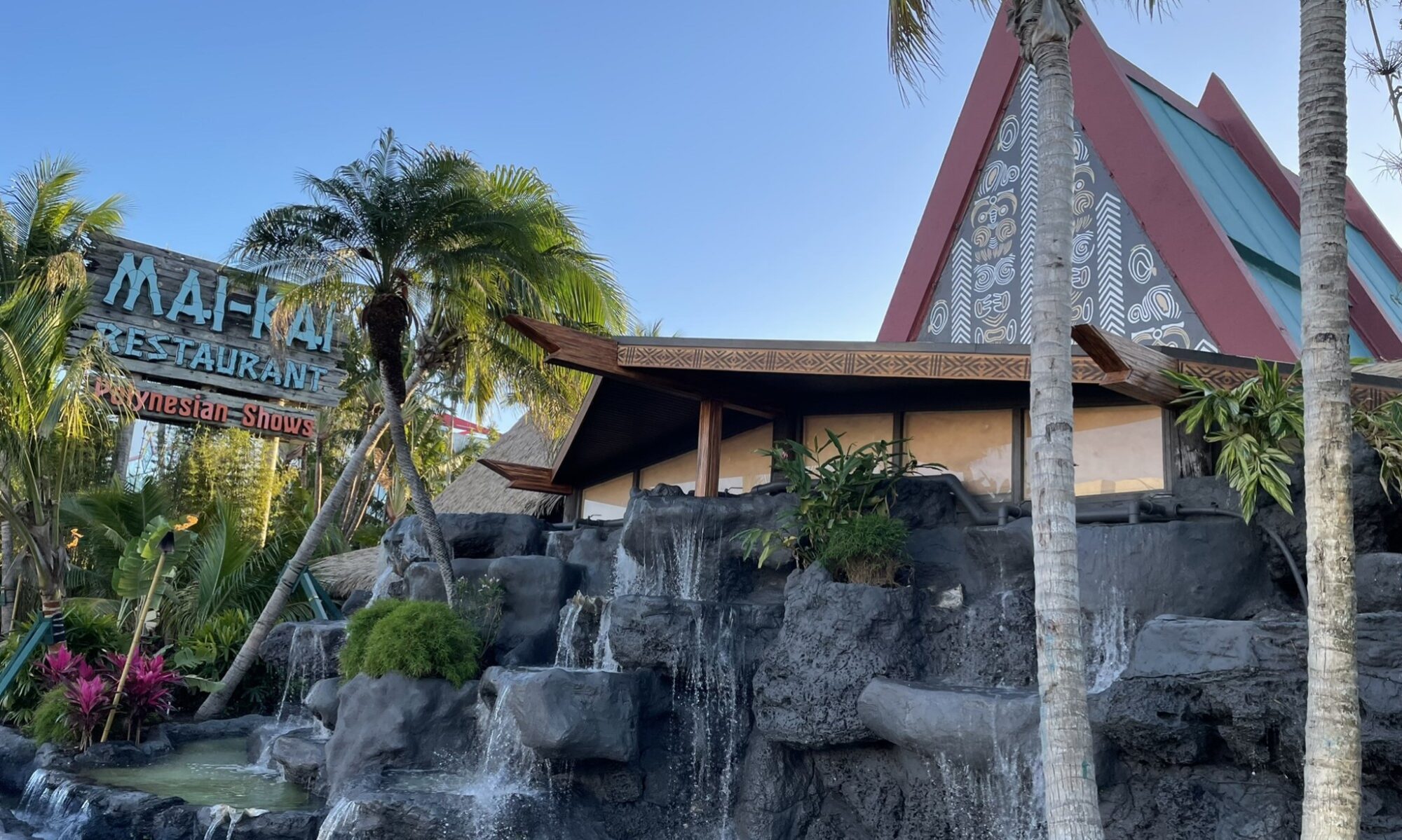
Long considered a “Tiki temple” by its fans and followers of timeless mid-century Americana, The Mai-Kai can now stake a claim to being an official South Florida landmark. And to honor its 57th anniversary this month, the venerable Polynesian restaurant has scheduled several special events.
(Photo by Hurricane Hayward)
Mai-Kai events * Friday, Dec. 27: Surf rock party with The Novarays, 6-9 p.m. in The Molokai bar. * Saturday, Dec. 28: Customer celebration party, 1:30-4 p.m., featuring a showing of the PBS documentary Plastic Paradise. Where: The Mai-Kai, 3599 N. Federal Highway, between Commercial and Oakland Park boulevards. Valet and paid self-parking. Call (954) 563-3272 or go to MaiKai.com.
In November, The Mai-Kai became the first commercial property to receive historic designation by the city of Oakland Park. While the restaurant is typically listed as being in Fort Lauderdale, it sits in the southeast corner of the small city to the north of its larger South Florida neighbor. The designation by the city’s Historic Preservation Board was in honor of The Mai-Kai’s history and architectural character. A national historic designation is also being sought.
Like a fine barrel-aged rum, the new magnum opus from Tiki cocktail historian Jeff “Beachbum” Berry benefited from years maturation, developing a rich depth of flavor and nuance. When Potions of the Caribbean: 500 Years of Tropical Drinks and the People Behind Them is finally uncorked next week, it will undoubtedly be savored to the last drop by a growing legion of fans.
It could also quite possibly be Berry’s last call as a self-proclaimed “layabout” author. While the carefree image will likely remain, Berry’s other much-anticipated project could soon make him a much busier Bum. The former screenwriter, whose six books since 1998 have sown the seeds of the Tiki cocktail revival, will be embarking on a new career next year when he opens his own bar in New Orleans.
These plans are accelerating, Berry confirmed in an e-mail this week, and he hopes to sign a lease at an undisclosed location by the end of the year. That would put him on track to open his Tiki bar (in partnership with Mrs. Bum, aka Annene Kaye) as early as spring 2014. They already have a designer, architect and key staff lined up. In the meantime, Berry’s solo career as a literary figure will reach its peak with the release of Potions of the Caribbean.
Berry’s sixth book on tropical drinks and the fascinating stories behind them, Potions of the Caribbean could be considered the sequel to Sippin’ Safari (2007), both in style and substance. Berry’s first three books were mainly spiral-bound drink recipe compilations, and his previous (Beachbum Berry Remixed, 2010) was a redesigned and expanded re-release of the first two.
But with Sippin’ Safari, Berry used his seemingly endless supply of vintage recipes, photos and artwork to embellish the stories of the bartenders, restaurant owners and other pioneers of the early days of Tiki. The result was a wonderful read – a beautifully illustrated cocktail guide, history book and retro culture travelogue all rolled into one. The new book follows this same format, with the stories taking a starring role and the recipes enhancing the narrative.
The rich history of the Caribbean and its role in the Tiki cocktail movement was actually supposed to be an additional chapter of Sippin’ Safari. A subtitle near the end of the book’s final chapter, which tells the story of Mariano Lucidine and The Mai-Kai, introduces the Potions of the Caribbean name while very briefly mentioning the birthplace of rum and its role in Tiki cocktails.
Berry explained his dilemma on the Oct. 29 episode of The Quiet Village podcast. “I was trying to cram all this stuff into one chapter,” he told host Digitiki. “After we talked about The Mai-Kai, I was just going to go down to Cuba and Jamaica. But I realized there was just way, way too much stuff to do that, so it became its own book, five years later.”
Filmed at Tiki events, bars and restaurants across the country and produced by Miami’s award-winning commercial and documentary filmmakers Common Machine, Plastic Paradise has finally been released to PBS affiliates. It was commissioned by Miami affiliate WLRN, where it premieres this Wednesday (Sept. 18) at 8 p.m. It will air again on WLRN on Thursday at 2 a.m., Friday at 7 p.m., and Monday (Sept. 23) at 11 p.m. It will also be carried by WXEL in Palm Beach County beginning on Saturday (Sept. 21) at 8 p.m. WLRN’s Plastic Paradise page also lists air times on PBS stations in Arkansas, Colorado, Illinois and Washington. It also encourages you to call your local PBS station if you want to see the documentary in your area.
The Hukilau was held June 6-9, 2013, at the Sheraton Fort Lauderdale Beach Hotel (aka the Yankee Clipper) and The Mai-Kai restaurant. See below:Gallery of 40 photos
The Intoxicators from Tallahassee unleash a surf-rock fury in The Molokai lounge during Thursday’s late-night bash. (Atomic Grog photo; click for gallery)
More than 800 devotees of Polynesian Pop culture and classic mid-century style assembled for the 12th annual gathering of the tribe known as The Hukilau in Fort Lauderdale. Despite inclement weather that forced some venue and schedule changes, the colorfully-clad attendees didn’t seem to mind, flocking to a wide assortment of events showcasing eclectic music, rum-filled cocktails, expert speakers and lots more.
Below are the highlights of The Atomic Grog’s whirlwind weekend, which began early in the week with organizational efforts and didn’t end until Sunday’s post-event party at The Mai-Kai. I missed one band and a couple symposiums, but I tried to hit all the major happenings and photographed the revelry for posterity (see photos below). For extensive photo coverage, click on the Go11Media link below the gallery.
The following is highly subjective but should give a fair snapshot of the wide array of festivities, along with a few tasty cocktail recipes. I apologize to any bands and participants I may have neglected to mention, but all did a great job. It was tough narrowing this list down to 10. In roughly chronological order …
When The Mai-Kai updated its cocktail menu in May 2018, a decision was made to revive one of the classic “lost cocktails” from the notebook of original mixologist Mariano Licudine, who led the bar program from 1956 to 1979. There were nearly a dozen to choose from, many of them ionic drinks that Licudine had brought with him from his days working for Don the Beachcomber in the 1940s and ’50s.
The Suffering Bastard, a longtime off-menu “lost classic,” was added to the permanent menu in May 2018. (Photo by Hurricane Hayward)
Over the past five years, these lost cocktails have been featured at multiple special events, from The Hukilau to The Mai-Kai’s 60th anniversary party. In 2017, a special “Flashback Friday” promotion gave guests the opportunity to sample a different retired cocktail each month on that designated day. While many were popular, one stood out and earned a spot on the main menu, even though it was never on the menu to begin with.
The Suffering Bastard was de rigueur at mid-century Tiki bars. Like many other popular tropical cocktails of the era, it was bastardized (pun intended) and retooled to fit the needs of each particular establishment. The Trader Vic’s version was perhaps the most well-known, instantly recognizable by the iconic Suffering Bastard mug.
The Mai-Kai was no exception, but for reasons unknown it never appeared on the menu. Taking a cue from Trader Vic, Licudine created his Suffering Bastard as an alternative take on the Mai Tai. Of course, The Mai-Kai’s Mai Tai is nothing like Vic’s, and neither is the Suffering Bastard. Licudine did appropriate one distinctive touch from Vic: A large slice of cucumber as garnish. As odd as it seams, it really does work.
The Mai-Kai’s version of the Suffering Bastard features a cucumber garnish, first popularized by Trader Vic. (Photo by Hurricane Hayward, May 2018)
The original Suffering Bastard, sans cucumber, was created in 1942 at Shepheard’s Hotel in Cairo by mixologist Joe Scialom, a fascinating story uncovered by tropical drink historian and author Jeff “Beachbum” Berry. Scialom’s recipe – which includes gin, brandy, Rose’s lime juice, Angostura bitters and ginger beer – was revealed in the 2010 book, Beachbum Berry Remixed. An entire chapter is devoted to Scialom in Berry’s 2013 epic hardcover, Potions of the Caribbean: 500 Years of Tropical Drinks and the People Behind Them.
Before Berry and other Tiki revivalists came along in the 1990s, many of these classic cocktails were long forgotten. Without a slot on the menu at The Mai-Kai, it’s possible that the Suffering Bastard languished for decades in Licudine’s notebook before being rediscovered. The latest version includes a few new tweaks, so we’ve added a new tribute recipe below.
The humble Daiquiri is arguably the most definitive rum cocktail, perhaps even the prototype for the 20th century tropical drink explosion. It influenced Don the Beachcomber, Trader Vic, and countless others who followed in their footsteps.
Cuba’s most famous cocktail can be traced back to the late 1800s, but the simple combination of rum, lime and sugar was not groundbreaking. Martinique and Guadeloupe had the Ti Punch while Jamaica had its Planters Punch. An argument can be made that this intoxicating combination was invented on the high seas in the 1700s, when the British Navy introduced Grog to its sailors.
Though deeply linked to Cuba, the Daiquiri was actually invented by an American engineer, Jennings Cox, who ran a mining company in the small village of Daiquiri during the Spanish-American War. The original was more like a punch, batched and served over crushed ice. It was not reconfigured into a single cocktail, strained into an empty coupe, until around 1913, after Cox’s death
That’s when the Daiquiri really began to take off. Its popularity grew from a local favorite to a destination drink for tourists who flocked to the Caribbean island’s legendary bars such as Havana’s La Floridita, especially during Prohibition. It also caught the attention of Facundo Bacardi, who used the simple drink to promote his expanding rum empire.
A vintage Bacardi ad from Cuba. Havana’s La Floridita and owner/bartender Constantino Ribalaigua Vert became known worldwide for perfecting the craft of the Daiquiri.
It’s likely that both Donn Beach (aka Don the Beachcomber) and Victor Bergeron (aka Trader Vic) ran across the Daiquiri during their travels in the Caribbean before opening their bars in California that kick-started the Tiki cocktail craze in the 1930s.
Their menus are loaded with Daiquiris, much like The Mai-Kai. Open since 1956, the South Florida historic landmark still features many drinks that can be traced back to Donn Beach, such as the Special Reserve Daiquiri.
There’s also a blended classic (Floridita Daiquiri) and an acclaimed original creation of mixologist Mariano Licudine, the Derby Daiquiri.
Of all the Daiquiris that appeared on a Mai-Kai menu, the Cuban Daiquiri is the only one that faded into the history books. It was an opening-day drink in 1956, but it likely became a victim of the era’s political upheaval, not to mention the U.S. economic embargo against Cuba that began in 1960 and lasts to this day.
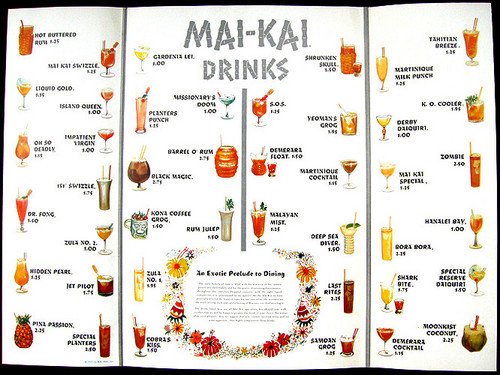
The Mai-Kai’s 1956-57 menu, which featured the Cuban Daiquiri (upper right).
Before the 1958 revolution, Mai-Kai owners Bob and Jack Thornton were known to take weekend jaunts to the island aboard a private plane. They brought back rare bottles of Cuban rum, which can still be found displayed in the restaurant’s back bar (see photo below).
The Derby Daiquiri took the Cuban Daiquiri’s place on the menu in 1959. It was revived during a menu expansion in the early 1970s, but it was removed for good in the 1980s and became largely forgotten.
The Daiquiri was sullied during the cocktail dark ages of the late 20th century by cheap imitations and dreaded frozen slushie-style machines. But the classic recipe maintained a quiet dignity. The traditional Daiquiri has seen an amazing resurgence during the 21st century craft and Tiki cocktail revival.
Most classic cocktails at the venerable Mai-Kai Polynesian restaurant – both existing and retired – are descendants of Prohibition-era Tiki bar pioneer Don the Beachcomber. But even when it’s clear which drink is the ancestor, it can become a challenge to pinpoint the correct version.
This tendency of Don the Beachcomber namesake Donn Beach to create multiple versions of the same drink became a point of frustration for tropical drink historian and author Jeff “Beachbum” Berry as more and more historic recipes turned up. One of the most confusing cases is that of Beachcomber’s Gold. Berry devotes five pages in his 2010 book, Remixed, to this dilemma and explores three different recipes.
All three are authentic and represent different eras in Beach’s career. Our task was to find the one that was most likely known best by original Mai-Kai mixologist Mariano Licudine when he created the restaurant’s 1956-57 menu and a drink called Liquid Gold. We also sought the drink that fit The Mai-Kai’s distinctive cocktail style.
Over the course of more than 50 years, the outstanding tropical drinks at The Mai-Kai restaurant have proved to be both enduring and mysterious. And some of the biggest mysteries involve those “lost classics” that no longer appear on the menu, such as the Island Queen.
I thought I had this mystery solved, posting this review last week declaring the drink a rare original concoction by the late, great Mai-Kai mixologist Mariano Licudine. But it appears I was out-sleuthed by another master, Tiki bar historian and author Jeff “Beachbum” Berry. As the Bum correctly pointed out soon after I published the original Island Queen review, it bears a striking resemblance to Don the Beachcomber’s Queen’s Road Cocktail, which appears in his excellent 2007 book, Sippin’ Safari. (Be sure to read the chapter on Licudine and The Mai-Kai.)
So after further research (see ancestor recipe below), the genealogy of the Island Queen has been updated to include it on the long list of Mai-Kai cocktails that are retooled versions of classics created in the 1930s and ’40s by Tiki bar pioneer Donn Beach, aka Don the Beachcomber. The updated Mai-Kai family tree now lists a total of 40 drinks (including 31 on the current menu) that can be traced back to Beach, who originally hired Licudine at his Hollywood, Calif., flagship restaurant back in 1939. Prior to that, Licudine spent five years as a private chauffeur and personal mixologist for the legendary Laurel and Hardy comedy team.
Mod Weekend, the March 15-17 celebration of Fort Lauderdale’s mid-century architecture and style, is shaping up to be a whirlwind of activity with several events selling out and additional activities added to the mix, including Saturday’s “Mai-Kai: History, Mystery and Adventure” seminar.
The Mai-Kai under construction in 1956. (Photo courtesy of The Mai-Kai)
While not officially part of Mod Weekend, the presentation by Mai-Kai historian Tim “Swanky” Glazner will fit right in with the theme of recognizing the historical significance of this Polynesian treasure, which was built in 1956. The restaurant’s Molokai lounge will open at 2 p.m. for a special happy hour, followed by the narrated, multimedia slideshow at 3 p.m. in the grand showroom. Seats are limited, so call (954) 563-3272, ext. 1, to make a reservation. Admission is free.
* The Mai-Kai’s Facebook event
The event will also be a reunion for Mai-Kai “veterans,” with many former employees who worked there as far back as the 1950s expected to be on hand. On Sunday, Mod Weekend returns to The Mai-Kai on its double-decker bus tour. The first tour was sold out, so a second has been added, according to the official website. The tour will include another presentation by Glazner as well as a walking tour of The Mai-Kai’s extensive dining rooms, gardens, and Polynesian artifacts. The weekend’s festivities wrap up Sunday night with a closing party at The Mai-Kai at 8 p.m. Tickets are $50 for the bus tour and $25 for the closing party. Go to ModWeekend.com for the latest information on tickets and availability.
Interest in classic mid-century design and style has been building for decades, coinciding with a general distaste among many for the throw-away culture of the late 20th century that continues unabated. At the core of the modern esthetic is the one-of-a-kind architectural movement that followed World War II and flourished until the upheaval of the late 1960s.
This golden age of style coincided with other classic movements – such as Tiki, Googie and Atomic Age – all morphing into one gigantic era that arguably produced mankind’s first true culture of cool. It took the success of TV’s Mad Men to bring “mod” style to the 21st century masses, but support from an enthusiastic core of supporters has never waned.
In Palm Springs, Calif., arguably ground zero for vintage mid-century modern architecture in the United States, the eighth annual Modernism Week is in the midst of an 11-day celebration expected to draw more than 25,000 retro enthusiasts. Featuring bus tours, cocktail parties, lectures and films, Modernism Week is billed as “the only such event in the country.”
That distinction ends in March, when Mod Weekend makes its debut in Fort Lauderdale. Like California, Florida is a treasure trove of shining examples of the movement. Both experienced construction booms during the ’50s and ’60s, the height of the era. And Fort Lauderdale, like Palm Springs, is a hotspot for mid-century style, from its distinctive beachfront hotels to its vintage housing developments.