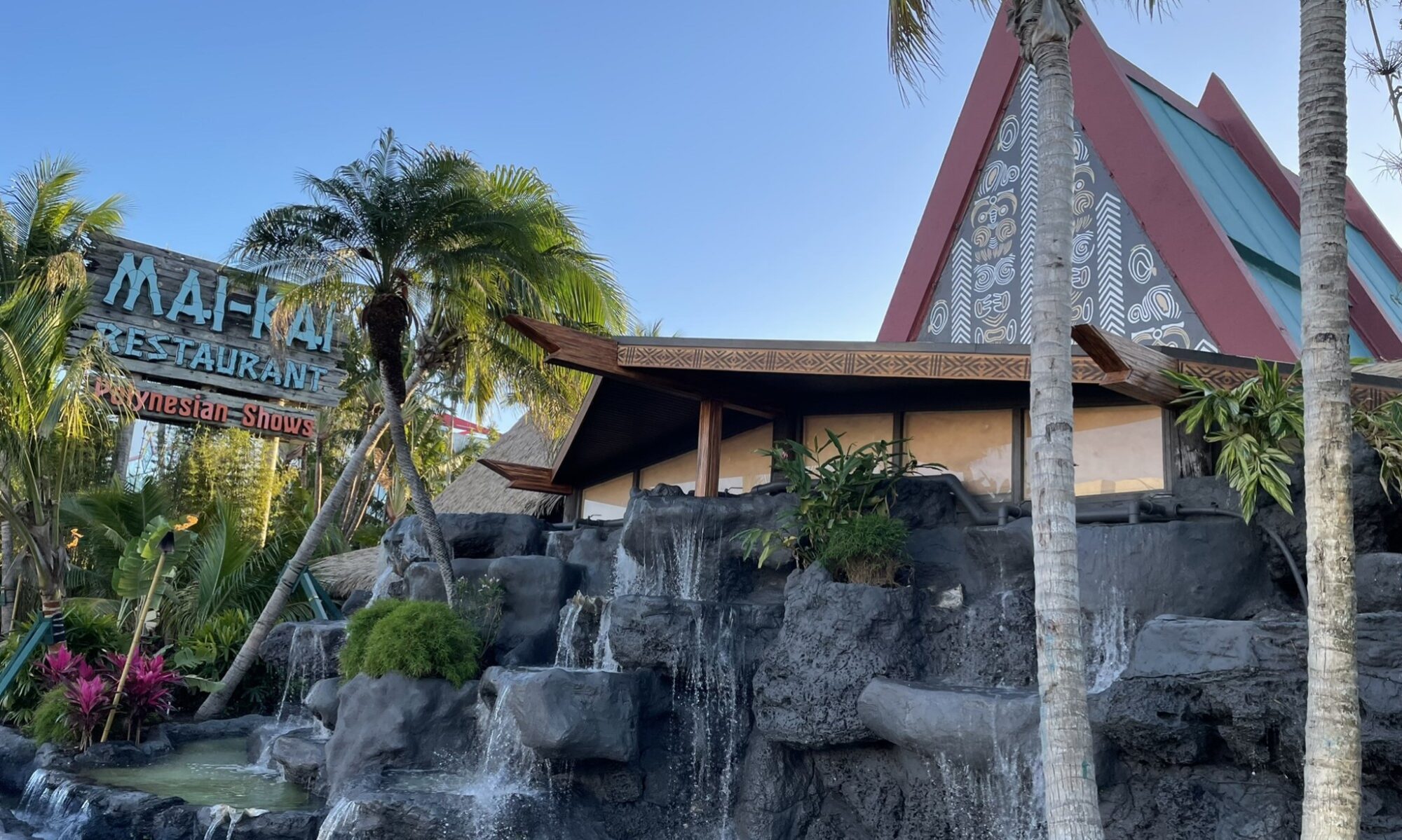
Kern Mattei in his office at The Mai-Kai, July 2011. (Photo by Susan Hayward)
This is the second in The Atomic Grog’s series of short interviews with noted personalities involved in events, music, art, cocktails and Tiki/retro culture.
Kern Mattei was destined to be general manager of The Mai-Kai. His father, Kern Sr., held the same position at the legendary Polynesian palace from 1964 to 1991. His mother was a Mai-Kai dancer, and he literally grew up in the restaurant. He was born in 1966, 10 years after it opened, and now works in the same office that his father did.
He worked a variety of jobs at The Mai-Kai while in school, then began as a manager in 1993 after earning a bachelor’s degree in hospitality from Florida International University. Kern lives in Fort Lauderdale with his wife, Elke, and two children: Cheyne and Nicholas. I conducted this interview with the always dapper Kern on July 30.
Few realize that the Zombie – not the Mai Tai – is the drink that kicked off the tropical drink craze. Created in the 1930s by the Dr. Frankenstein of tropical mixology, Donn Beach (aka Don the Beachcomber), the Zombie remains his masterpiece.
Beach’s mad scientist approach to combining multiple rums, juices, syrups and spices was groundbreaking and set a standard that remains an influential touchstone for today’s bartenders in both the Tiki and craft cocktail worlds. But if it weren’t for cocktail sleuth, historian and author Jeff “Beachbum” Berry, we might not have ever discovered that legacy.
Berry rescued the Zombie (and many other Tiki classics) from bad bartending and half-assed attempts to re-create the originals. But his first attempt at the Zombie in his seminal 1998 book, Grog Log, was not a whole lot better than the imitators. By 2002, however, he had begun to unearth some great Zombie recipes, three of which are published in his second recipe book, Intoxica. One of these, later dubbed the “mid-century version” and purported to be a Don the Beachcomber recipe published in 1950, is shown below.
But Berry was just scratching the surface of Zombie lore. His 2007 masterpiece, Sippin’ Safari, yielded the motherlode. An entire chapter, “A Zombie Jamboree: The Curse of the Undead Drink,” provides the definitive research on the elusive cocktail. There’s more background on the 1950 Zombie, plus a much different 1956 version attributed to the Don the Beachcomber restaurant in Waikiki.
Beachbum Berry mixes a classic Zombie at the Zombie Jam at The Mai-Kai on April 25, 2011.
The pièce de résistance, however, is Berry’s discovery of a 1934 recipe for “Zombie Punch” in the notebook of 1930s Don the Beachcomber bartender Dick Santiago. The find was considered the Holy Grail of lost tropical drinks, but one frustrating puzzle remained to be solved: the cryptic ingredient listed as “Don’s Mix.” This combination of grapefruit juice and cinnamon syrup has now become a common ingredient, but the 2007 revelation was a landmark in the Tiki drink world. Berry and Cocktail Kingdom later released a 10th anniversary edition of Sippin’ Safari, which includes additional recipes, both old and unpublished, plus new ones from the Tiki revival.
* BeachbumBerry.com: More on Berry’s search for the original Zombie | Books and Total Tiki online + app
In 2010, Beachbum Berry Remixed continued the tradition of digging deeper into the history of the drink that started it all. In addition to the discoveries in Intoxica and Sippin’ Safari, Berry presented several new recipes, including a simplified version of the complex creation. You can also find Berry’s Zombie recipes in his Total Tiki app for iPhone and iPad, a unique repository of more than 250 exotic drink recipes from yesterday and today. Launched in 2022, Total Tiki Online is subscription service accessible via all platforms that takes the app to the next level with exciting new information management features.
If you desire a more tactile way to enjoy Berry’s handiwork, pick up a set (or a case) of his signature Zombie Glasses from Cocktail Kingdom, which include the original 1934 and 1950 recipes on the side along with distinctive artwork and packaging. They’re also available at the author’s New Orleans bar and restaurant, Beachbum Berry’s Latitude 29, along with the Bum’s own twist on the vintage recipe.
A contemporary Zombie from “Beachbum Berry Remixed.”
In addition to his acclaimed books, app and barware, Berry had a profound influence on today’s Tiki and cocktail scenes over the past decade or two by way of his entertaining and boozy symposiums around the world. His first-ever Zombie seminar took place at The Mai-Kai in April 2011 during the Miami Rum Fest. He resurrected that talk at The Hukilau in April 2012, again at The Mai-Kai, with a few additional surprises. [Full coverage]
Of course, The Mai-Kai’s Zombie is a descendant of Don the Beachcomber’s classics. There’s a reason it’s the top-rated cocktail in this guide, and the only one with a perfect rating of 5 out of 5 stars. Perhaps its the complex, undefinable flavors. The Zombie stands atop the tropical cocktail mountain as a true original with its intense flavors and high potency.
Despite its seeming cacophony of flavors, the Zombie (when made correctly) achieves perfect balance. The combination of spices are exotic and unique. The sweet juices and syrups are counteracted by intense anise and sour notes. And the coup de grâce is the blend of three rums in perfect harmony.
The Mai-Kai’s cocktail menu includes many drinks that have survived since the Fort Lauderdale Polynesian palace’s inception in 1956. Our unofficial count is 33 originals among the current menu’s 47 cocktails. The origins and recipes for some of these have long been mysteries, and we hope this guide unravels a few.
From Sippin' Safari: This vintage photo shows Mariano Licudine displaying his rum collection in 1962.
But even more mysterious are the great lost cocktails of The Mai-Kai. Those drinks that appear on early menus but for one reason or another were retired or replaced. Among the 12 of these that we’ve been able to identify are such exotic temptations as the Impatient Virgin, Dr. Fong and Liquid Gold. Those three, along with many others, were descendants of Don the Beachcomber cocktails that original Mai-Kai bartender Mariano Licudine reconfigured after spending decades learning from tropical drink originator Donn Beach.
This connection, along with the rich history of The Mai-Kai, is detailed in depth by cocktail historian Jeff “Beachbum Berry” in his excellent 2007 book, Sippin’ Safari. This lavishly illustrated guide is recommended not only for all the great recipes, but for the stories behind the cocktails that you won’t find anywhere else. Look for a special 10th anniversary edition – featuring new recipes, photos and stories – to be released in July 2017.
Beachbum Berry's Sippin' Safari is the source for Don the Beachcomber's Rum Julep and many other classic recipes.
You’ll find many Rum Julep recipes online, but don’t be fooled by these pretenders. It’s a common name given to a myriad of cocktails that all pale in comparison to the Don the Beachcomber classic, circa 1940. And as you should know from reading this cocktail guide, 40 of the Mai-Kai’s best drinks are direct descendants of Donn Beach originals.
When former Don the Beachcomber bartender Mariano Licudine created The Mai-Kai’s menu in 1956, he used many recipes from his notebook, but tweaked them slightly. These altered drinks also got new names, such as Don’s Swizzle becoming the Mai-Kai Swizzle or the Never Say Die becoming the Oh So Deadly. However, a few kept their original moniker, such as the distinctive Zombie and Kona Coffee Grog.
Still, there were subtle changes in most drinks. Much like the Special Planters Punch, it took quite a few years before I attempted a Rum Julep tribute recipe, as the finer points of Mariano Licudine’s mixology techniques became clearer. And like many of those other cocktails, the Rum Julep is a fine example of tropical drink history that only The Mai-Kai can provide.
The Deep Sea Diver, one of the oldest and most distinctive tropical drinks at Fort Lauderdale’s Mai-Kai, can be traced back to the 1930s and tropical drink pioneer Don the Beachcomber’s original cocktail menu. It also features an unusual, rarely used ingredient that remains somewhat of a mystery more than 75 years later.
From a mid-century Don the Beachcomber menu.
Tiki drink historian Jeff “Beachbum” Berry’s excellent 2007 book, Sippin’ Safari, includes a recipe for the Peal Diver’s Punch that you’ll find below as well as an entire chapter on The Mai-Kai’s founding mixologist, Mariano Licudine (1907-1980). Licudine worked behind the bar at Don the Beachcomber restaurants from 1939 until 1956, when he was lured to Fort Lauderdale by The Mai-Kai’s fledgling owners, Jack and Bob Thornton.
Sippin’ Safari remains my favorite of the Bum’s books and perhaps the most influential in fostering appreciation of both the roots of tropical mixology and the history of The Mai-Kai. It details how Licudine took the Don the Beachcomber classics he had been making for years in Chicago and adapted them to The Mai-Kai’s new menu. With the help of Bob Thornton, Licudine tweaked the secret recipes, often elevating them to even greater heights.
The prototype of the Planter’s Punch dates back 200 years and could be considered the template for every tropical drink that followed. The Mai-Kai’s strong Special Planters Punch is an overlooked classic on a cocktail menu full of classics. Just don’t confuse it with the medium-strength (and much less flavorful) Planters Punch.
In his 2010 book, Remixed, Tiki cocktail historian Jeff “Beachbum” Berry theorized that Donn Beach discovered the Planter’s on one of his rum-running trips to Jamaica during Prohibition. Click on the article at right for Berry’s excellent research on how the Planter’s Punch influenced nearly every 20th century Tiki drink, from the Q.B. Cooler to the Zombie.
Of course, Donn Beach went on to open the world’s first Tiki bar, Don the Beachcomber, in 1934 in Los Angeles. He had five versions of the Planter’s Punch on his 1930s bar menu, Berry writes in Remixed. Of those, Don’s Own Planter’s (see recipe below), is most likely the version that inspired The Mai-Kai’s Special Planters Punch. If you’ve been following these reviews, you’ll know that The Mai-Kai’s original mixologist Mariano Licudine was privy to Donn Beach’s recipes during his 16 years working at Don the Beachcomber restaurants in L.A. and Chicago.
The annual gathering of the Tiki tribe in Fort Lauderdale, which just celebrated its 10th anniversary, will be moving to April for its 2012 edition. It had been held in early June for the past five years.
Los Straitjackets at the Bahia Cabana in Fort Lauderdale during Hukilau 2009. (Photo by Go11Media.com)
“The Hukilau has moved to April in order to accommodate more outdoor activities at a cooler time of year and to give fans more time between all the great Tiki events out there,” said co-founder and longtime producer/organizer Christie “Tiki Kiliki” White.
White has posted the 2012 dates as April 19-22. Final plans have yet to be announced, but look for more events taking place at The Mai-Kai, the legendary Polynesian restaurant that has been the centerpiece of The Hukilau since it moved from Atlanta in 2003.
Plans also call for a return to the Bahia Cabana at the south end of Fort Lauderdale Beach, which has been the longtime hotel of choice for Hukilau revelers. Its poolside stage has been host to a great lineup of retro-inspired bands, such as Los Straitjackets, The Woggles, and Tikiyaki Orchestra.
More than 75 years after its invention, the Mai Tai is widely hailed as the definitive tropical drink. You’ll get some arguments from Zombie fans like myself, but there’s no denying that the Mai Tai is one of the world’s most popular and distinctive cocktails, period.
The Mai Tai (front) is one of The Mai-Kai’s signature drinks. (Photo by Go11Events.com, courtesy of The Mai-Kai; waitress: Maima)
We subscribe to Berry’s theory that Trader Vic created the Mai Tai after tasting a Don the Beachcomber drink with a similar flavor profile called the Q.B. Cooler. Donn Beach, who created the Tiki bar concept in 1934 in Los Angeles, also had a drink called the Mai Tai Swizzle, but it was gone from the menu by 1937. It’s widely accepted that Vic frequented Don the Beachcomber in Hollywood before opening his first Trader Vic’s in Oakland. Could he have lifted the name from one drink and the flavor profile from another in creating his Mai Tai?
It’s entirely possible, but that has nothing to do with The Mai-Kai, or its version of the Mai Tai. The Mai-Kai already serves a descendant of the Q.B. Cooler called the K.O. Cooler (See our previous review). If you’re looking for the taste of a proto Trader Vic’s Mai Tai, try the K.O. Cooler.
The Mai Tai served at The Mai-Kai is one of many variations created in the wake of the success of the original drink. You’ll find some good examples from vintage Tiki restaurants in Beachbum Berry’s cocktail books and app, including the Bali Hai Mai Tai, Damon’s Mai Tai, Kon-Tiki Mai Tai and Surf Room Mai Tai. Until recently, many bars offered an inferior or bastardized copy. But the Tiki and craft cocktail movements have resulted in a much more creative atmosphere, especially where the Mai Tai is concerned. Check out the links below for examples:
* Florida bartender wins Chairman’s Reserve Mai Tai Challenge at The Mai-Kai
* More Mai Tai recipes on The Atomic Grog
A Mai Tai at The Mai-Kai in April 2013. (Photo by Hurricane Hayward)
In the mid-century, however, The Mai-Kai was not quick to jump on the Mai Tai bandwagon. The cocktail has not been spotted on a menu before 1970 (see image). It’s missing from all previous menus in our collection, including this one from 1966.
At first, it was likely an off-menu drink made upon request, like the Scorpion and Suffering Bastard, two other Trader Vic’s classics popular with many guests. The latter finally made it to The Mai-Kai’s menu during the last major update in 2018.
Rather than copying Vic’s recipe, Mai-Kai mixologist Mariano Licudine put his own spin on the Mai Tai (and Suffering Bastard), owing to his roots as one of Don the Beachcomber’s early Filipino barmen. He worked behind one of Donn Beach’s original Hollywood bars in 1939 before becoming assistant bar manager at the Chicago location during his years there (1940-1955). He joined The Mai-Kai as bar manager in 1956, crafting its opening day menu with owners Bob and Jack Thornton.
Our expedition through the mysterious tropical drink selection at The Mai-Kai takes a dangerous turn with another mid-century classic from the menu’s “STRONG!” offerings.
The Shrunken Skull, served in the Abelam mug in May 2012. (Photo by Hurricane Hayward)
Tongue-in-cheek drinks lionizing primitivism were common during Tiki’s golden age. The ominous Shrunken Skull and its variations were among the most infamous. The idea was to conjure up a sense of danger lurking in your local tropical getaway. Classic Tiki bars offer the ultimate escape from the mundane day-to-day existence, and every island adventure needs a little bit of macabre yet kitschy risk-taking.
In this case, the danger lies in the strong rums that permeate this deadly concoction. The Shrunken Skull is one of only two current Mai-Kai drinks that feature a rum floater (a shot of rum added to your drink as it’s served). Not coincidentally, the other also comes with an element of danger attached to its name: the Shark Bite.
The Shrunken Skull is also one of only a handful of Mai-Kai cocktails to come in its own custom mug, originally a vintage shrunken head design by Al Kocab. The artist had his hand in many projects at The Mai-Kai, from furniture to advertising design.
It was replaced some time in the 1980s by a modern version based on Kocab’s design that remains to this day. The modern version features the details painted under the glaze, while the vintage version has the details painted over the glaze.
Our collection includes Mai-Kai Shrunken Skull mugs from the 1960s (left), 1970s and 1980s. (Photo by Hurricane Hayward)
The above links and info come courtesy of My Tiki Life, a website featuring a user-generated database of mugs past and present. This highly recommended resource is so robust, in fact, it lists nearly 300 mugs (as of October 2023) with a tag of “skull.” Featuring photos, designer and manufacturer info, plus a full description of the mugs, mytiki.life is essential even if you don’t register as a member.
In recent years, the Shrunken Skull is also often served in a modern Abelam mug, which features a mask-like design of the Abelam people who live in the East Sepik province of Papua New Guinea. The original was also designed by Kocab.
Both mugs have a handle, which is atypical of most Tiki mugs. It’s usually an indication that the mug does double-duty on the dessert menu as a vessel for hot coffee drinks. At The Mai-Kai, the current Abelam mug also can be enjoyed with an after-dinner classic, the flaming Kona Coffee Grog. The Shrunken Skull mug is also used for the Tahitian Coffee.
The 16 deadly drinks in the “strong” section are no doubt the stars of The Mai-Kai’s legendary cocktail menu. There’s a reason they comprise 13 of the Top 20 in our rankings. They’re by far the most inventive, mysterious and flavor-packed drinks on the menu.
The only thing more dangerous than a 151 Swizzle: Two 151 Swizzles. (Photo by Hurricane Hayward, January 2015)
Just be careful when imbibing. The Mai-Kai doesn’t use the word “strong” lightly. Some contain 3 ounces of rum (or more), others a healthy dose of overproof. Among these, there are “strong” drinks and then there are “STRONG!” drinks. In the latter category, one of the first cocktails that comes to mind is the classic 151 Swizzle.
Like many Mai-Kai drinks, this deliciously dangerous concoction dates back to Tiki originator Donn Beach (better known as Don the Beachcomber) and has been on the Fort Lauderdale restaurant’s cocktail menu since its opening in 1956. It has become an iconic standard at some of the world’s top Tiki bars, from the 60-year-old Tiki-Ti in Los Angeles to more recent additions such as False Idol in San Diego. At Hale Pele in Portland, The Mai-Kai gets a shout-out in the menu description, and the presentation is very familiar. It’s likely they’re using a variation of one of our seven tribute recipes below.
Martin Cate, one of the world’s top rum and Tiki cocktail authorities, considers the 151 Swizzle his favorite drink on The Mai-Kai’s menu. [See interview] “When it’s made perfectly, it’s a wonderful drink,” he said. “That to me is my mothership.” At his acclaimed Smuggler’s Cove in San Francisco, he serves a souped up version called the 2070 Swizzle, which he calls “my giant killer.” [See recipe]
The Swizzle Cup is part of the Tiki barware collection produced by Cocktail Kingdom in association with Jeff “Beachbum” Berry. (Cocktail Kingdom photo)
Revealed in Jeff “Beachbum” Berry’s groundbreaking 1998 cocktail guide, Grog Log, the original Don the Beachcomber recipe is fairly simple (see below). As the cocktail sleuth pointed out in the book, it was originally served in a metal cup with a flared top, “but good luck finding one.” The Mai-Kai, of course, follows tradition and has always served its 151 Swizzle in a chilled metal cup.
Finding the correct cup outside of the handful of bars mentioned above, however, has traditionally been difficult. You could typically find a Mint Julep cup or other close approximation on eBay, but they fall short of the sleek, flared design of the original. Berry took matters into his own hands in May 2015, when he released a new line of Tiki barware via Cocktail Kingdom including a Swizzle Cup.
• Check out our story on the barware
When metal cups are in short supply, this is how you’re likely to be served the 151 Swizzle at The Mai-Kai. (Photo by Hurricane Hayward, January 2017)
Beyond the cup, The Mai-Kai’s version of the 151 Swizzle is unlike any other. Like many Mai-Kai drinks, it’s based on the Don the Beachcomber version but was given a unique twist by original owner Bob Thornton and mixologist Mariano Licudine, who learned his craft from Donn Beach. We’ve taken a stab at re-creating the same flavor profile and have posted an ever-evolving list of “tribute recipes” below. Like Thornton, his stepson Dave Levy also tinkered with the recipe from time to time when he was in charge over the past 30 years, especially when changes were made to the rums.
The recipe grew out of discussion on The Grogalizer, a site highly recommend if you’re a fan of classic Tiki cocktails. Developed by Tim “Swanky” Glazner, author of the upcoming book Searching for Don the Beachcomber, The Grogalizer is a database of hundreds of recipes from all of Beachbum Berry’s books, plus a few select others. The site allows you to rate the drinks, see how other mixologists rank them and share comments on each.
Sign up (it’s easy) and keep track of your progress through all the great recipes in these books. It’s also a seamless way to keep track of all the various bar ingredients you’ll need to re-create these classics, which include many in this guide. After compiling your online bar, you can figure out which drinks you can make with which ingredients, as well as resources for buying hard-to-find stuff. In September 2016, Glazner released his long-awaited book, Mai-Kai: History and Mystery of the Iconic Tiki Restaurant, an essential addition to any Mai-Kai fan’s collection.
Metal cups for the 151 Swizzle, along with other frozen glassware, are kept in a special freezer in The Mai-Kai’s kitchen service bar. (Photo by Hurricane Hayward, November 2011)
The evolution of the tribute recipe has gone through several stages, as you’ll see below. The first big breakthrough came in March 2012, when I discovered Kohala Bay, a rare dark Jamaican rum that was a key ingredient in many of The Mai-Kai’s strong cocktails. In addition, a search of eBay yielded a set of metal cups that were similar to the real deal. With the cup and rum in my arsenal, I were able to come up a much more accurate tribute recipe.
But just when I thought I had it down pat, The Mai-Kai dropped a bombshell in late April 2012 with the reintroduction of Lemon Hart 151 Demerara rum, which had been absent from its bars for some 15 years. This only made a great drink even better and returned it to its vintage recipe. This resulted in tribute recipes No. 2 and No. 3. The fourth variation of the recipe, created in early 2015 when Lemon Hart was replaced by Hamilton 151 rum from Guyana, is more complex and full of outstanding flavors.